|
 |
Strategy in the Era |
|
| Over the past 250 years, the pace of change has increased at an increasingly rapid rate. Few enterprises are able to offer lifetime employment anymore; not because they don��셳 want to, but because they usually don��셳 survive long enough. |
|
|
 |
arnessing Co-opetiti |
|
| In the ���90s, businesses became increasingly aware of the ecological component of business strategy. Many began to look beyond the simplistic view of raw competition to embrace the concept of ��쐃conomic symbiosis.��� In the process, complexity and speed of change redefined business alliances. The Internet, ERP, and other tools have made the ��쐃xtended enterprise��� a reality, and leading-edge firms began to encourage mutualism. |
|
|
 |
Farm-Shoring Brings |
|
| As widely reported, senior managers ?focused on cost-cutting ?have been sending jobs off-shore to places like Bangalore, for more than a decade. |
|
|
 |
Genetics Meets Innov |
|
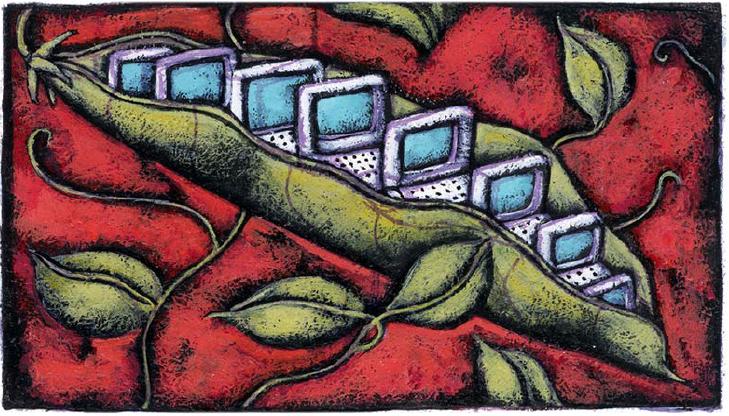
| In the field of genetics, scientists develop stronger species of corn and other crops through a process known as ��쐓eed, select, and amplify.��� First, they use a diverse range of seeds to grow several different varieties of the crop under various conditions, such as drought, frost, heavy rainfall, and so on. Then they select the seeds from the sturdiest and most productive strains of each generation of crops and cross-breed those with the desired trait for use in the next generation of test crops. Ultimately, over many generations, the scientists develop super-crops that produce more food, resist all types of weather and pests, and require less soil and water. |
|
|
 |
Genetic Algorithms A |
|
| A significant challenge in managing today��셲 enterprise is quickly and effectively choosing among a large number of complex options and alternatives with subtle trade-offs. Fortunately, new computer applications using genetic algorithms can do a much better job at making these choices than a person using traditional analytical techniques. |
|
|


 [276]권

